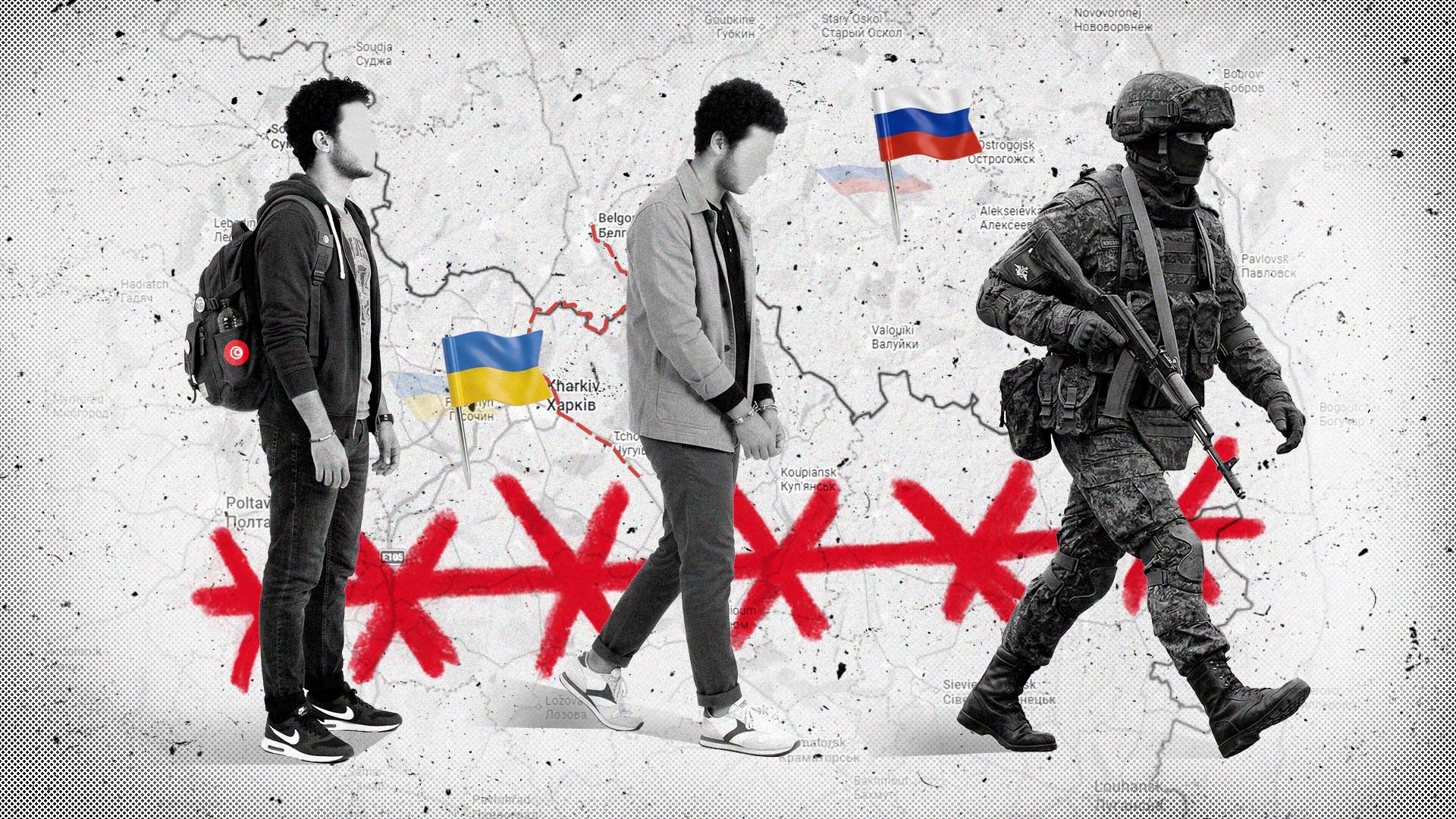
Since he passed through a military training center, the news has grown scarce. One final voice note reached his family announcing that he was being sent to the front. No news has been heard since. His family does not know where he is now. Or whether he is still alive.
In another Tunisian household, the same waiting has settled in. Montassar left Tunisia in 2021 to study computer science in Russia. A few months after arriving, he too was arrested in a drug-related case, under circumstances his relatives still describe as murky. He went through prison. His family speaks of pressure and violence. Then, in 2025, he signed a contract with the Russian army. A military order assigned him to a unit stationed near the Ukrainian border. From the combat zone, he sent a voice message. He spoke of a sky thick with drones, of trenches where men hide, of fear that never lifts.
What their families have pieced together — through voice notes, court decisions, and military orders — sketches a pattern that extends far beyond these two cases. According to a report published in February 2026 by the organization INPACT, at least 1,417 African nationals have been integrated into the Russian armed forces since the beginning of the war in Ukraine, as part of a structured recruitment campaign targeting, in particular, students and migrants in vulnerable situations .
On the same subject
An Illusory Departure, Followed by Arrest
Aymen and Montassar’s story echoes the experience of thousands of Tunisians studying overseas. Their families describe university enrolments, accommodation secured on arrival, and the search for work to make ends meet. Initially, both trajectories follow
a familiar pattern of settling abroad: administrative adjustment, financial constraints and dependence on migration status.
Aymen left Tunisia on November 11, 2022, to study business administration. His study plan was facilitated by an institute presenting itself as a “multinational center for language training, academic support and immigration assistance.”
Before his departure, Aymen even appeared in
a promotional video released by the institute. Speaking on camera, he said he wanted to ‘complete his studies quickly in Russia,’ highlighting the range of available programs and the possibility of enrolling even without a baccalaureate. He said
he had contacted the institute via Facebook, selected his faculty from the options offered, and received an official invitation for study. ‘The visa took no more than a month,’ he added.”
The text accompanying the video states that the institute ‘supported him through the travel procedures until the visa was obtained’ and was present on the day of departure. The agency promises to ‘facilitate all steps, from admission to a Russian university
through to graduation.
Once there, he settled in the Voronezh region. He completed a preparatory year in Russian before beginning his degree. At the same time, he worked to support himself. According to his father, ‘he studied while working in agriculture, in greenhouse farms,
and even in construction.
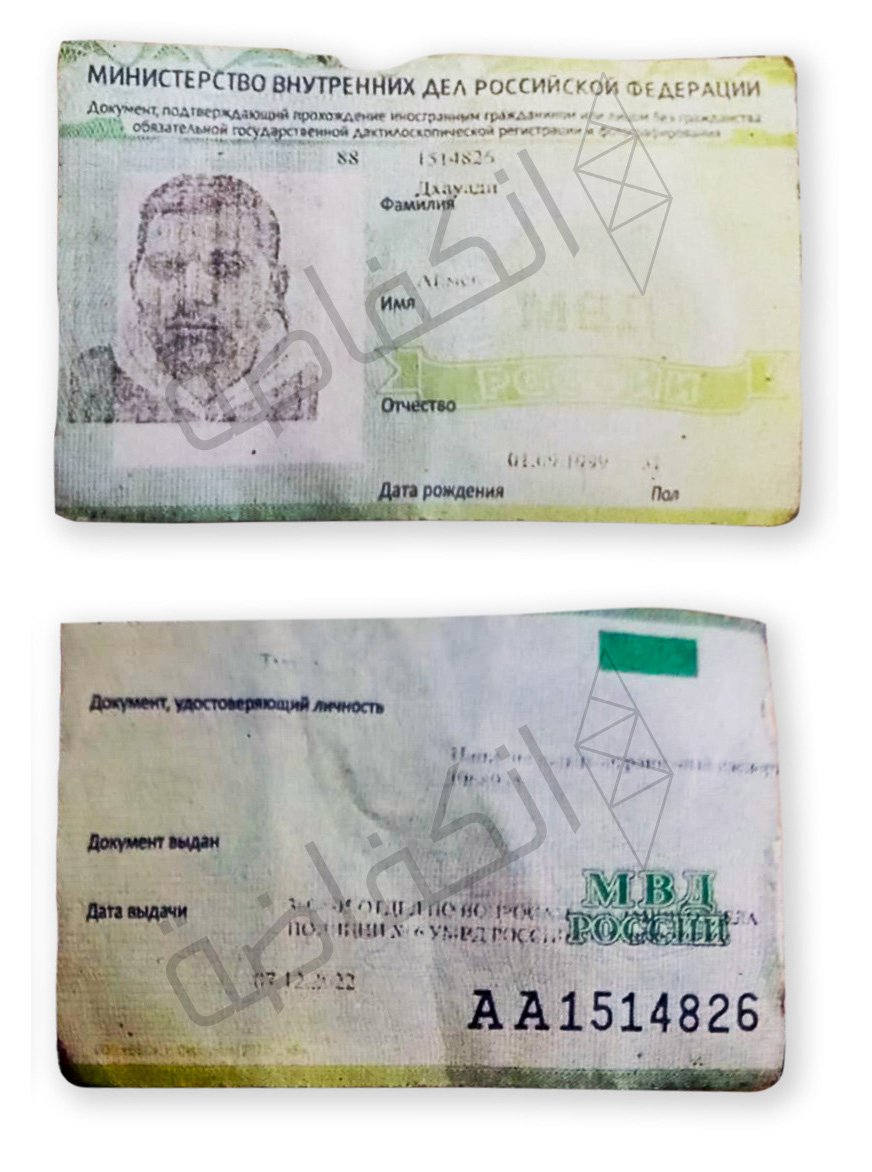
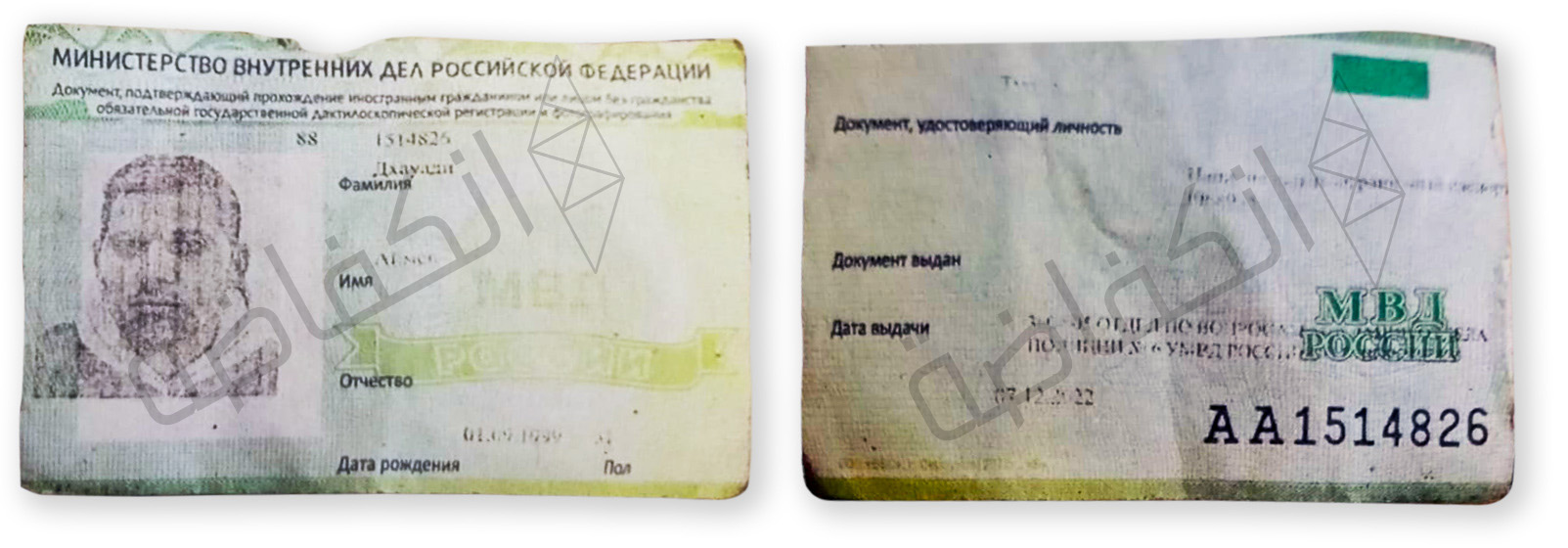
Registration card issued by the Russian Ministry of the Interior in the name of Aymen Dhaouadi. This document certifies the administrative registration of a foreign national
on Russian territory.
At the start of his third year, he is said to have gone through a difficult financial period that forced him to stop working, according to his brother. While looking for a new job, he came into contact, via Telegram, with a Russian national who presented
himself as the head of a delivery company. The man asked him to send a copy of his passport and instructed him to go to a specific address for what was described as a preliminary training placement.
Aymen went there with his Moroccan friend, Moussa, also a student, studying pharmacy. According to the family’s account, the address was located in a remote area on the outskirts of the city, at the edge of a forest. Unable to find the exact location,
they reportedly asked a police patrol for directions. ‘We came to this address looking for work,’ they said. The officers allegedly told them the area was known for drug-related activity before placing them under arrest. Aymen and his friend were taken
into custody. The case then took a different turn.
Further north, in Bizerte, Montassar left Tunisia on November 12, 2021. He had not obtained his baccalaureate that year. According to his sister, friends told him about an agency offering study programs in Russia. The agency assured him that, even without a high school diploma, he could enroll in a Russian public university to study computer science. He decided to leave. ‘He sold his camera,’ his sister said. A photographer, he had worked for a Tunisian radio station and a television channel.
Seeking to improve his financial situation, Montassar came across an advertisement on Telegram in December 2021. He was offered a delivery job. ‘He was told it involved making deliveries, that he would be given locations where he had to drop things off,’.
According to his sister, he later discovered the deliveries involved heroin. ‘When he realized what it was, he refused to continue working with them.’ His refusal, she said, was not accepted. ‘They did not accept his refusal and set him up with the police.’
He was arrested on January 16, 2022.des indications à une patrouille de police. “
His relatives were informed by an individual linked to the agency that had arranged his departure. A translator was present at the time of his arrest. According to his sister, ‘the translator working with the police misinterpreted his statements,’ which,
she says, worsened the charges brought against him. From that point on, Montassar became caught in the machinery of the Russian penal system.
Detention as a breaking point
Following his arrest, criminal proceedings were initiated against Aymen and his Moroccan friend on drug-related charges. Judicial documents refer to an attempted offence under Article 30, paragraph 3, in conjunction with Article 228.1, paragraph 4 of
the Russian Criminal Code. In a
Facebook post, Aymen’s brother maintained that ‘my brother’s toxicology tests were negative, witnesses told investigators that the young men had no connection to drug trafficking, and surveillance cameras had never previously recorded them at the
site.
Despite these elements, the case moved forward. Aymen and Moussa were placed in pretrial detention at the FKU SIZO-1 detention center in the Voronezh region.
Faced with their son’s detention, Aymen’s parents quickly sought legal representation locally. From Tunisia, they retained a Russian lawyer through a Tunisian law firm operating on the ground. All exchanges were conducted remotely. Legal fees amounted to 150,000 roubles, or approximately 5,500 Tunisian dinars.
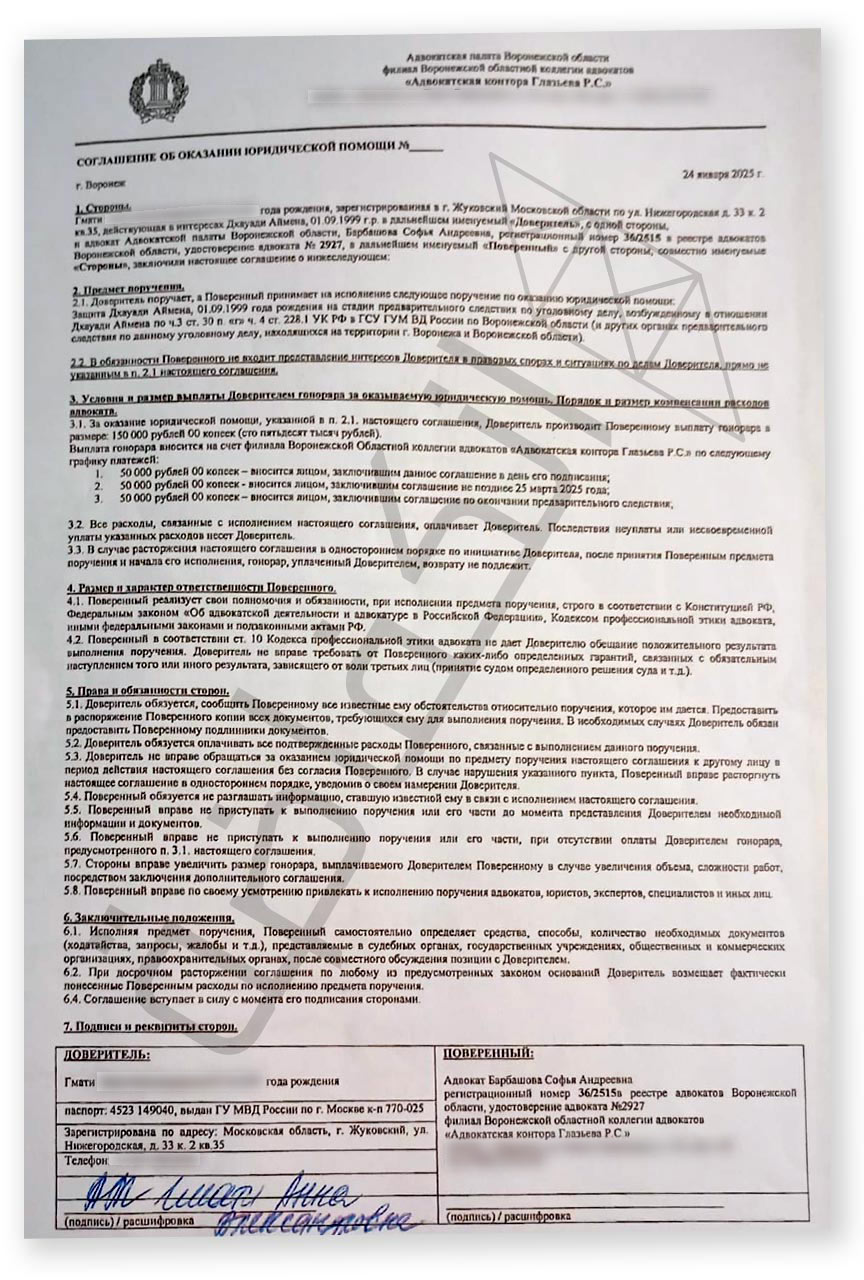
Legal assistance agreement signed with a Russian lawyer appointed to represent Aymen Dhaouadi during the preliminary investigation.
Legal assistance agreement signed with a Russian lawyer appointed to represent Aymen Dhaouadi during the preliminary investigation.
The parents do not speak Russian. They rely on a Tunisian intermediary to make payments and receive updates on the progress of the case. Each hearing is awaited as a possible turning point. According to his father, the detention lasted nine months, during
which they tried to follow the case without direct access to the hearings or the judicial authorities.
During this period, communication became increasingly strained.
‘He was harassed; they put immense pressure on him,’ said Hassan, Montassar’s father. One day, his son told him: ‘Dad, I couldn’t take it anymore. I just wanted to get out and breathe. I saw no other option—the only way out was to give in and accept it.’
That ‘accept’, according to judicial documents provided to the family, took the form of a military service contract signed during the mobilization period. On August 28, 2025, the Soviet District Court of Voronezh issued a ruling stating that ‘Aymen, a
Tunisian national, has entered into a contract to serve in the Armed Forces of the Russian Federation.’ On this basis, and in accordance with Articles 238, paragraph 1(5), and 253, paragraph 3.1 of the Russian Code of Criminal Procedure, the judge suspended
the criminal proceedings and lifted the pre-trial detention order.
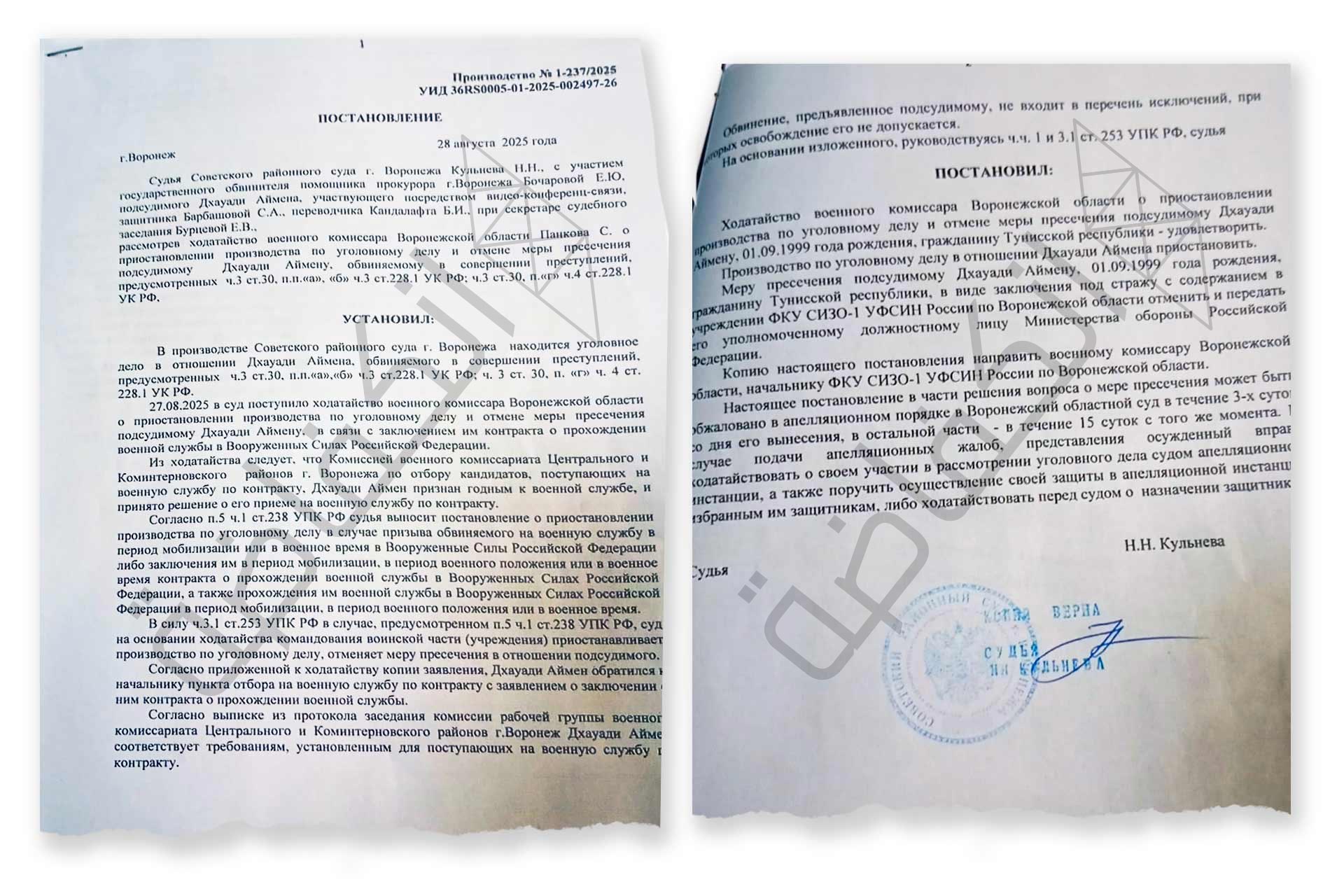
Russian court ruling suspending criminal proceedings against Aymen Dhaouadi following the signing of a military service contract.
The cited provisions allow for the suspension of criminal proceedings when a defendant signs a military contract during periods of mobilization or conflict. Since 2022, this mechanism has become a central tool in the recruitment of individuals who are
detained or facing criminal charges.
From the moment of his son’s arrest, Hassan says he made repeated attempts to seek help. He first contacted the Russian embassy in Tunisia, which told him it ‘had nothing to do with the matter.’ An intermediary then reached out to the Tunisian embassy
in Russia. Hassan himself went to the Tunisian Ministry of Foreign Affairs, submitted a request for a meeting with the presidency, and alerted the authorities ‘from the very first day of his arrest,’ warning that, in his view, his son risked being enlisted
into the army.
“To be honest, no one helped me. Even at the Foreign Ministry, they did nothing for me,” he says.
According to his account, the only step taken was to contact the consulate in Russia to monitor the case during his detention. He was later told, ‘there is nothing more we can do for you.’ A few days later, Aymen finally managed to contact his family
from a training camp.
Montassar, for his part, was arrested barely a month after arriving in Russia. According to his sister, he first spent a month and a half in detention, then was transferred to prison. He remained in pretrial detention for a year before being tried.
His family hired a Russian lawyer and contacted both the embassy and the Ministry of Foreign Affairs—steps that did nothing to alter the young man’s fate. At the end of the proceedings, Montassar was sentenced to six years in prison.
During the first months of his imprisonment, contact was maintained. His relatives sent him money and food through a Tunisian living in Russia. Communication remained regular.
The situation began to change from the summer of 2025. According to his sister, pressure inside the prison intensified. She described repeated placements in solitary confinement, acts of violence, and an increasingly harsh environment. ‘From August 2025,
he was subjected to very intense pressure in prison,’ she said.
It was through a former Egyptian cellmate that they learned Montassar had allegedly left the prison facility to join the Russian army. He is said to have signed a contract with the Ministry of Defence.
In both cases, military enlistment came after a period of incarceration. For both men, military service appeared as an alternative to the ordeal of Russian prisons.
Trading prison for war
The military documents we obtained make it possible to trace, with precision, the three weeks between Aymen’s release from prison and his deployment to the front. On August 29, 2025—the day after the court’s decision—the contract was signed. An official
certificate from the Voronezh Military Service Selection Point, issued in the name of Dhaouadi Aymen, a citizen of the Republic of Tunisia, confirms his enlistment in the Armed Forces of the Russian Federation for a period of one year, on the basis
of the federal law on military service.
On the same day, he was assigned the military personal number CA-210323 and the rank of private. The section reserved for his passport—series, number and date of issue—remained blank. On September 14, an AK-74 Kalashnikov, serial number 806673-77, was issued to him for personal use.
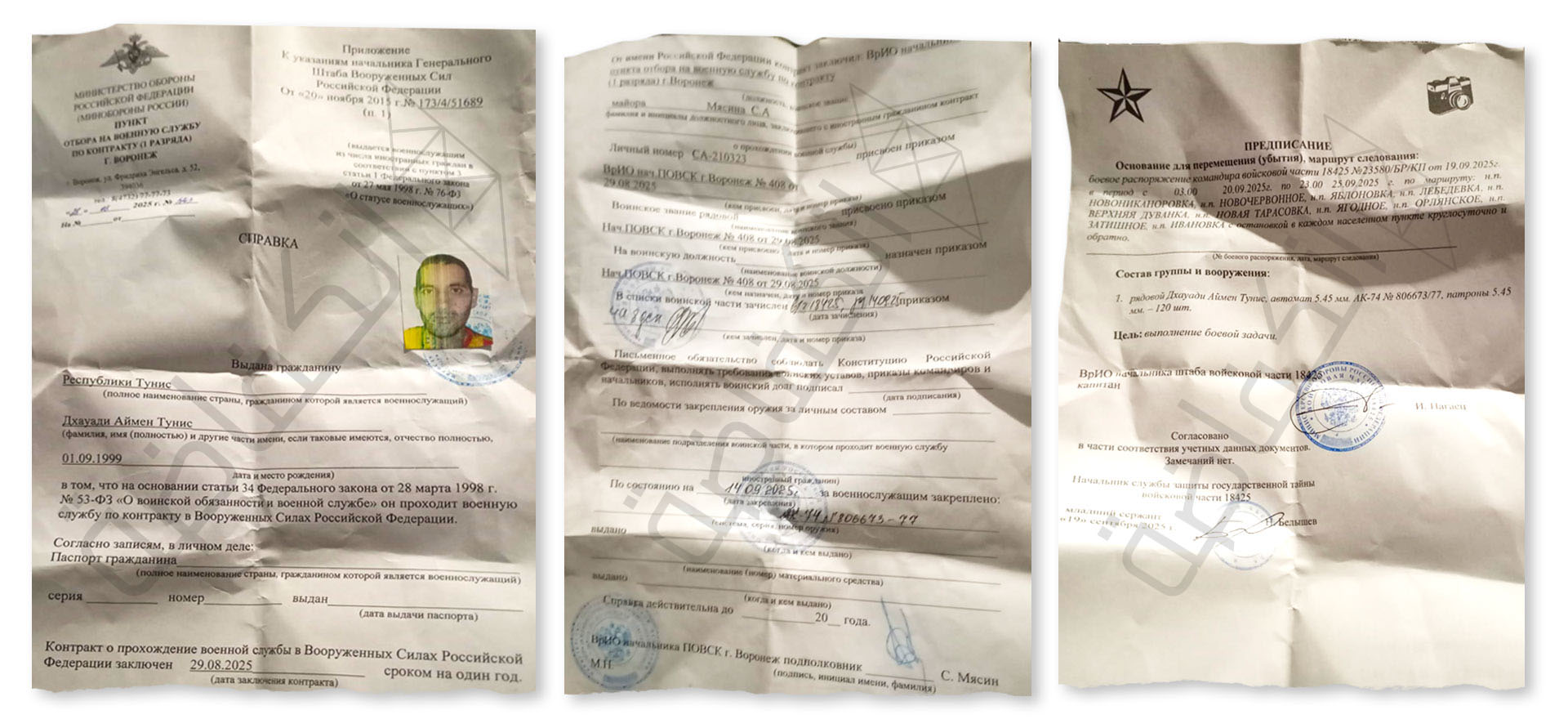
Russian military documents relating to the enlistment of Aymen Dhaouadi in the Russian armed forces. They indicate the signing of a military service contract on August29, 2025, in Voronezh,
and note his assignment to a unit engaged in military operations
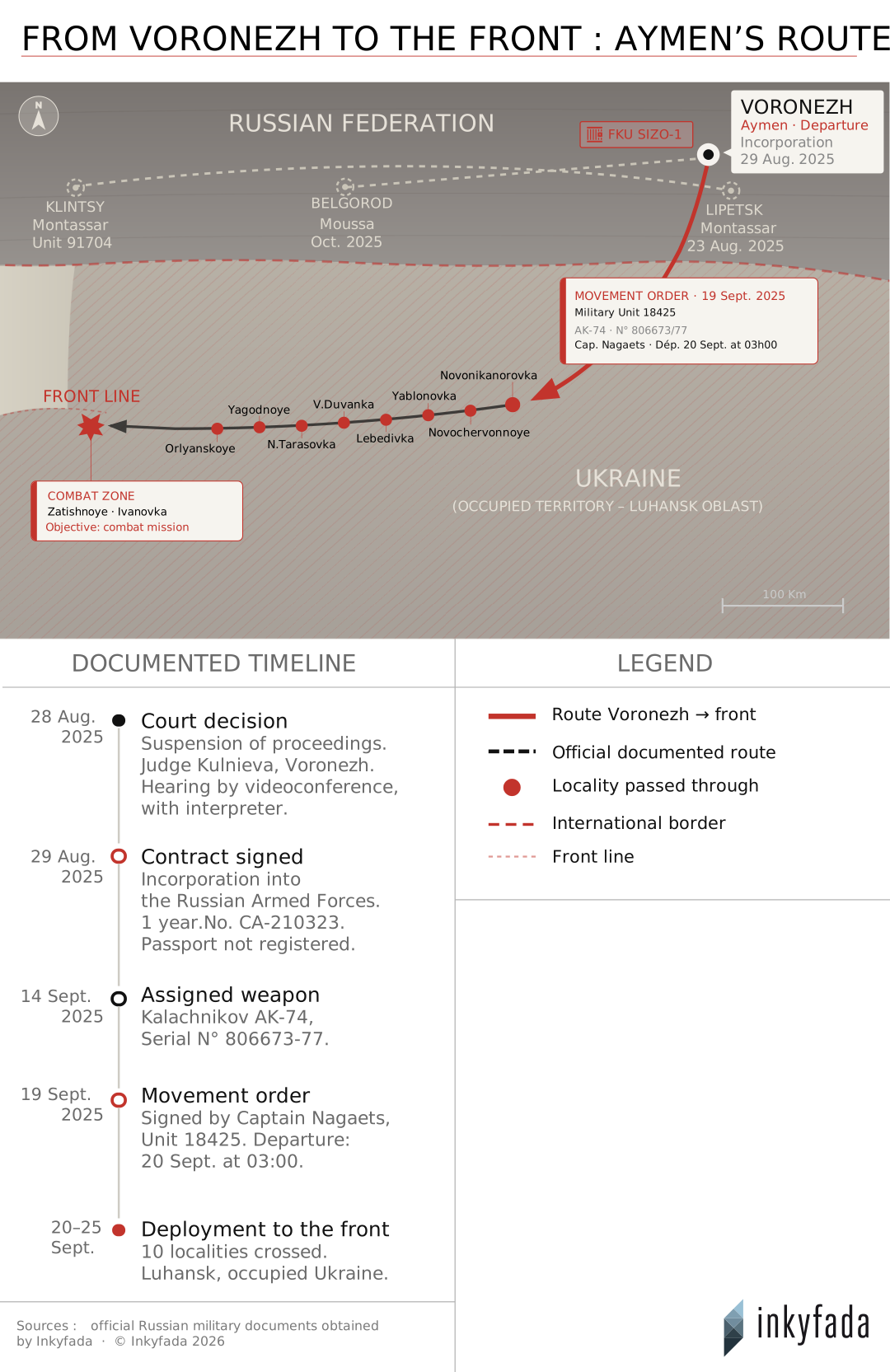
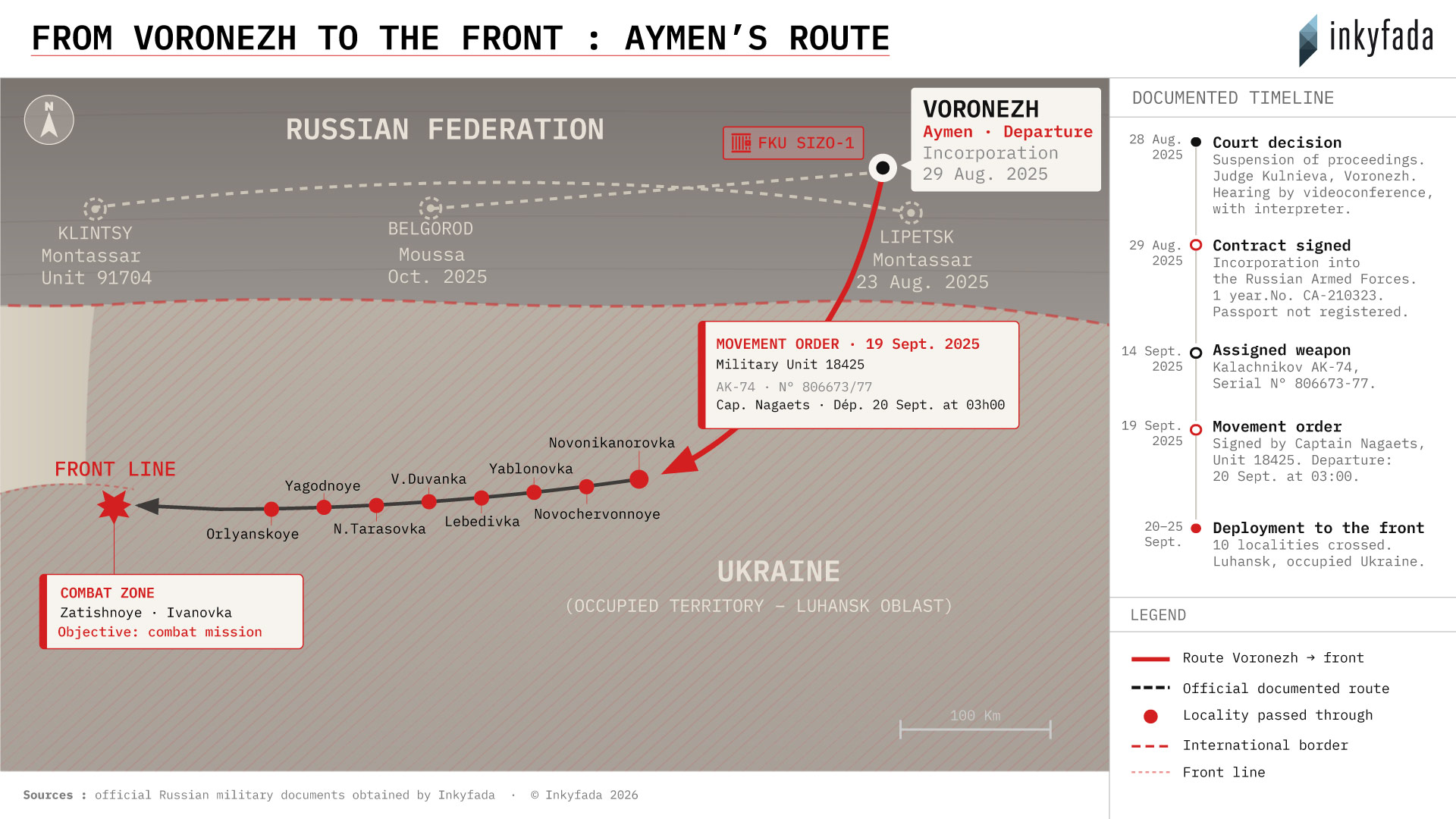
Five days later, on September 19, 2025, a movement order signed by Captain Nagaets, acting chief of staff of military unit 18425, deployed him on a combat mission to the Luhansk region, in occupied Ukraine, from September 20 to 25.
On the same day,
a Facebook profile under the name Аймен Джхауади—the Cyrillic transliteration of his identity—was updated with a photo showing him in combat gear. The setting visible behind him appears to be a wooden military position. It is not possible to establish
with certainty whether the profile was created by Aymen himself or by a third party. However, the соnsistency of the date, the name and the physical resemblance with the documents in our possession makes it consistent with his presence on the ground
at that time.
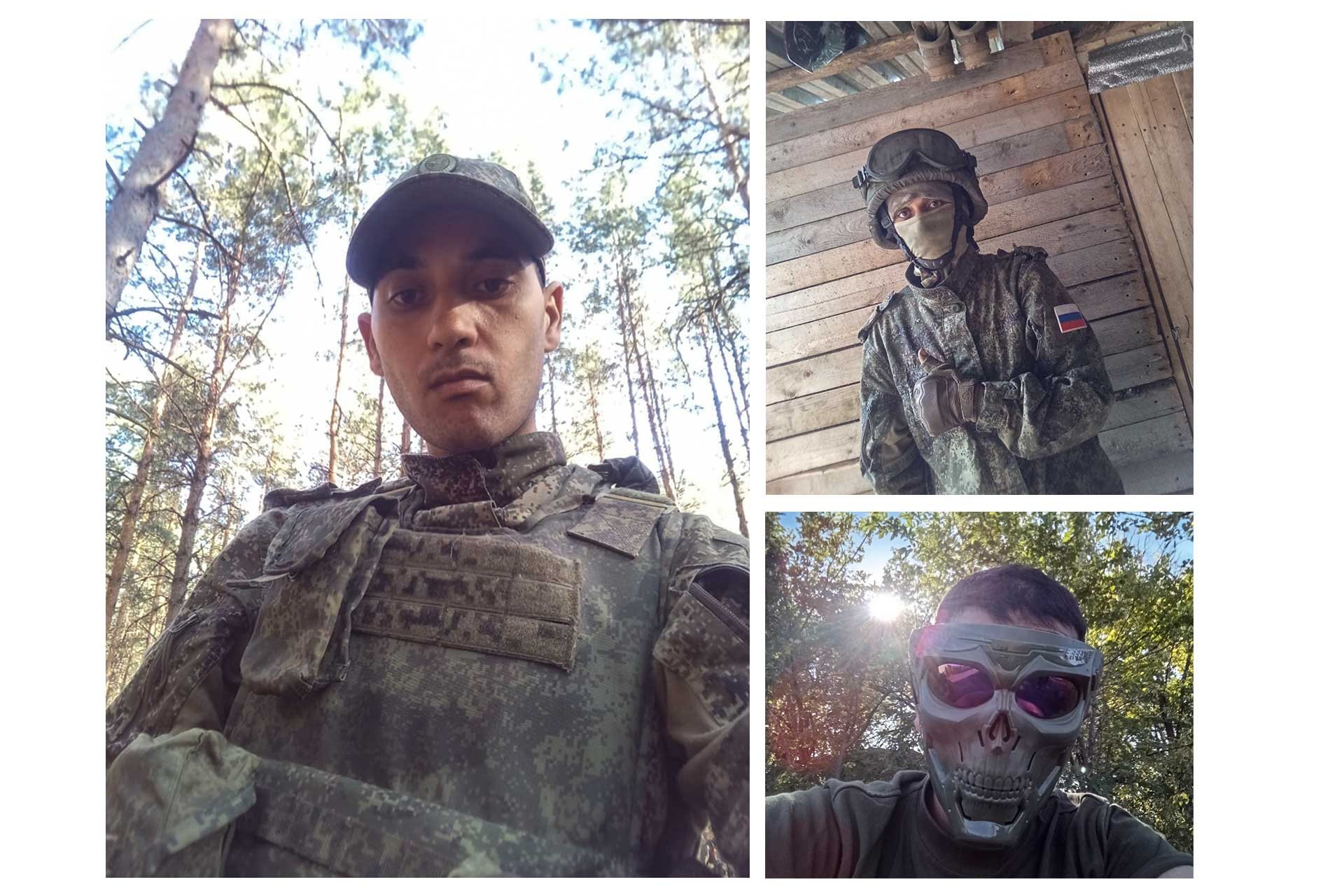
Photo of Aymen in military uniform sent to his relatives (left image). Photos shared by Aymen on his Facebook profile created during mobilization (right images).
The mission order details the route: Novonikanorovka, Novotchervonnoye, Yablonovka, Lebedivka, Verkhnaya Duvanka, Novaya Tarasovka, Yagodnoye, Orlyanskoye, Zatishnoye and Ivanovka, with a stop in each locality. These villages are located in the Luhansk region, in occupied Ukraine. The objective stated in the document, without further detail: execution of a combat mission.
In the days following his enlistment, Aymen was still able to communicate with his family. The messages were brief, sent whenever internet access was available. He said they had been moved several times—sometimes to places with no network, sometimes to
locations where Wi-Fi was briefly accessible. He did not know when they would be sent to the front. ‘Maybe today, tonight, tomorrow… no one knows anything,’ he said. Only five of them remained waiting. ‘All the others had already been sent.”
Aymen contacted his family after his release from prison
On September 19, he told his relatives he would be sent to the front the following day. His voice trembling and breaking into sobs, Aymen sent a message to his family that sounded like a farewell: ‘Tomorrow they will send me to war.’ He said they were
taking him ‘to a place where people have died.’ He asked his sister for forgiveness and urged her to pray for him. He warned that he might be without internet for an entire month.
Aymen’s message following his deployment order
On September 23, he managed to send one final message. He spoke about those who had left with him, those who had trained alongside him. Two had been killed. Then a third. He asked his sister to follow the news to understand how the war was evolving, as
information on the ground was circulating in a confused manner. ‘Here, everyone says something different. One tells you it will last two more years, another that it is about to end.’ Since that message, the family has received no further calls and has
no information about their son’s fate.
Aymen’s final message
For Montassar, the sequence is shorter and more opaque. After signing his contract at the end of August 2025, he managed to contact his family in September. He described the weeks leading up to his release from prison, speaking of pressure, isolation
and violence. ‘You don’t know what I went through in prison,’ he told his relatives. ‘I don’t even know how to handle a weapon.’ He said he had been deployed in less than a week.
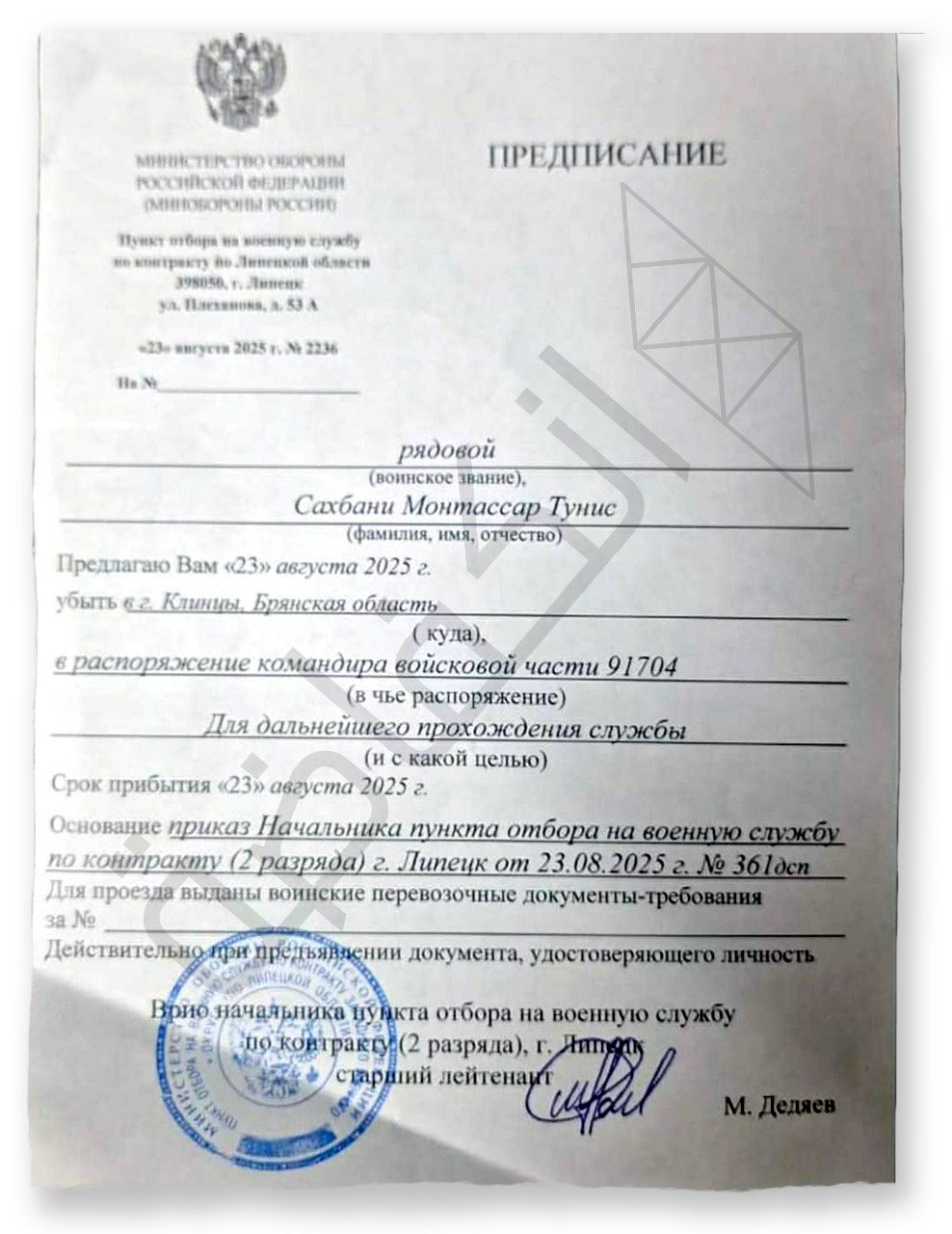
Military assignment order issued to Montassar Sabaani on August 23, 2025, instructing him to report to military unit No. 91704 in Klintsy, in the Bryansk
region.
Shortly afterwards, Montassar sent his family a military document dated August 23, 2025, issued by the Contract Military Service Selection Point in the Lipetsk region. It lists him with the rank of ‘private’ and orders him to report the same day to Klintsy,
in the Bryansk region, to place himself ‘at the disposal of the commander of military unit No. 91704 for the continuation of service.’
This number corresponds to the administrative format used for regular units of the Russian Ministry of Defence. Klintsy, located in the Bryansk region, lies in close proximity to the Ukrainian border. Since 2022, the area has been used as a staging and
transit point toward the northern front.
In the voice messages he later sent, Montassar describes an environment dominated by the threat of drones. ‘The only thing that’s frightening is the drones… every two or three minutes, you come across one.’ He speaks of devices flying at high speed, of
men hiding in trenches or among trees to avoid being spotted. He explains that internet access is turned on and off, and that information circulates poorly. The setting is that of an active combat zone. The last direct contact with him dates back to
September 12, 2025. Since then, there has been no communication.
Voice recording from Montassar
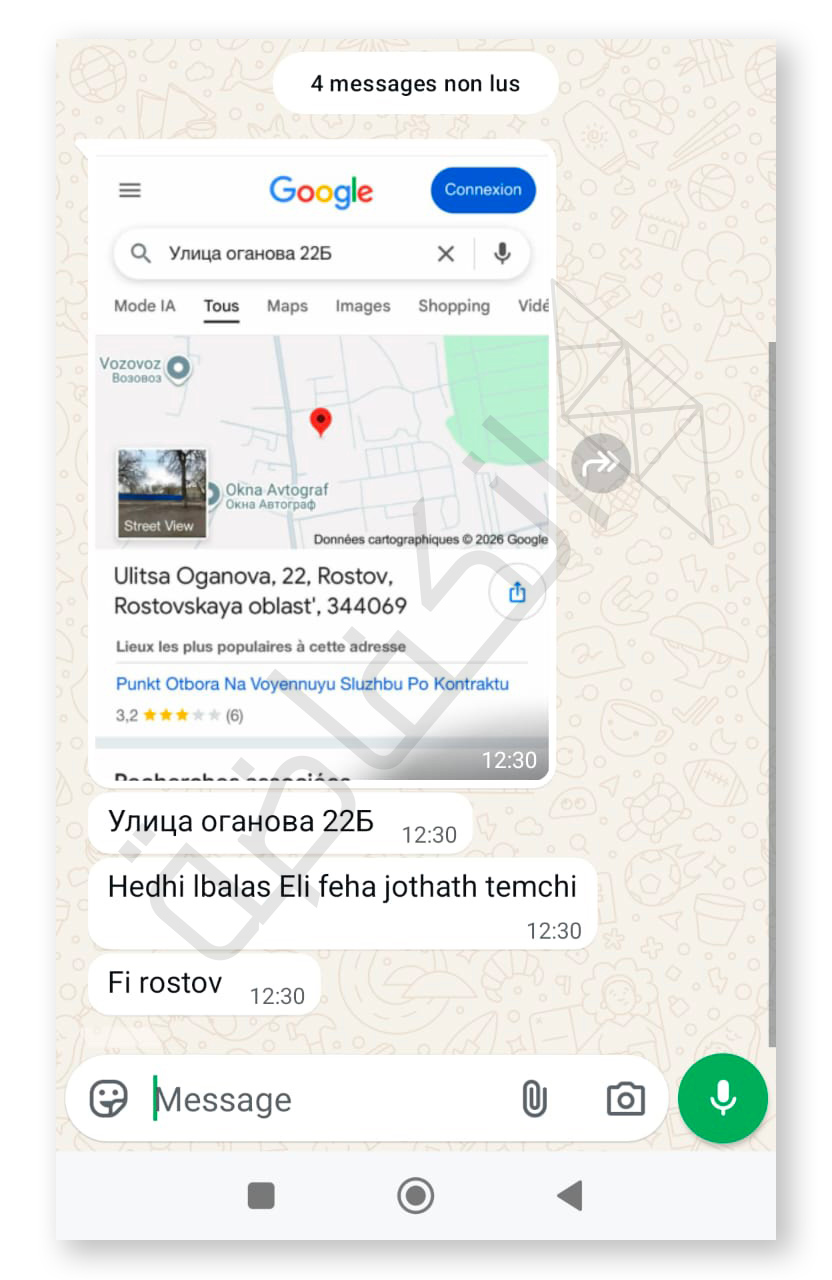
Message from Aymen’s Russian lawyer to his family, providing an address in Rostov-on-Don where the
bodies of several Tunisians were reportedly located
His relatives say they were informed by the Tunisian Ministry of Foreign Affairs that Russian authorities had reported Montassar missing since November. No document formally confirms his death. His Russian lawyer sent the family, via an instant messaging
service, an address in Rostov-on-Don presented as the location where the bodies of several Tunisians were said to be held. The address corresponds to an official contract military service selection center under the Russian Ministry of Defence. The link
between this center and the handling of deaths among foreign recruits has not been independently established at this stage of the investigation. In the absence of official identification, Montassar remains, for both the authorities and his family, classified
as missing.
The reference to
Rostov-on-Don is not incidental. As the headquarters of the Southern Military District—the operational command for the war in Ukraine—the city hosts the 78th Intelligence Center, which coordinated military supplies to Wagner, as well as a training
facility for recruits near the Ukrainian border. It was on a military site in Rostov that the first Wagner units were formed under the supervision of the Ministry of Defence. Since the start of the conflict, the city has functioned as the main rear
base and logistical hub of Russia’s military apparatus in the south, and as a documented transit point for foreign recruits being sent to the front.
How many others share Aymen and Montassar’s fate?
Aymen’s case is not an isolated one, even within his immediate circle. His Moroccan friend Moussa, arrested under the same circumstances and held alongside him at the Voronezh detention center, followed a similar trajectory. Their paths diverged, however,
at the point of assignment, due to an irregularity in Moussa’s administrative documents. It was by tracing this parallel case, in collaboration with our partner
Le Desk, a Moroccan investigative outlet, that we were able to cross-check and corroborate the information gathered on Aymen.
According to information obtained by our colleagues from Moussa’s sister, the contract he signed included specific commitments: a monthly salary of 50,000 dirhams—approximately €4,500—and the promise of Russian citizenship and a passport upon completion
of his service. He was paid twice before the payments stopped.
Sent to Belgorod in October 2025—a border city regularly exposed to Ukrainian strikes and a documented transit point to the front since the beginning of the conflict—he has been missing since November.
Montassar, Aymen and his friend Moussa are not isolated cases.
INPACT (Investigations with Impact), an independent platform specializing in hybrid warfare and Russian influence networks, published a report in February 2026 titled “
The Business of Despair.” In it, the organization analyzes a database of 1,417 African nationals enlisted in the Russian armed forces, obtained through the Ukrainian project
Khachu Zhit—a channel intended for soldiers seeking to surrender—and verified through cross-checking of digital traces. The authors themselves acknowledge that the list is incomplete and contains some inaccuracies in nationality. It nonetheless
identifies at least seven Tunisian nationals, including one reported as deceased.
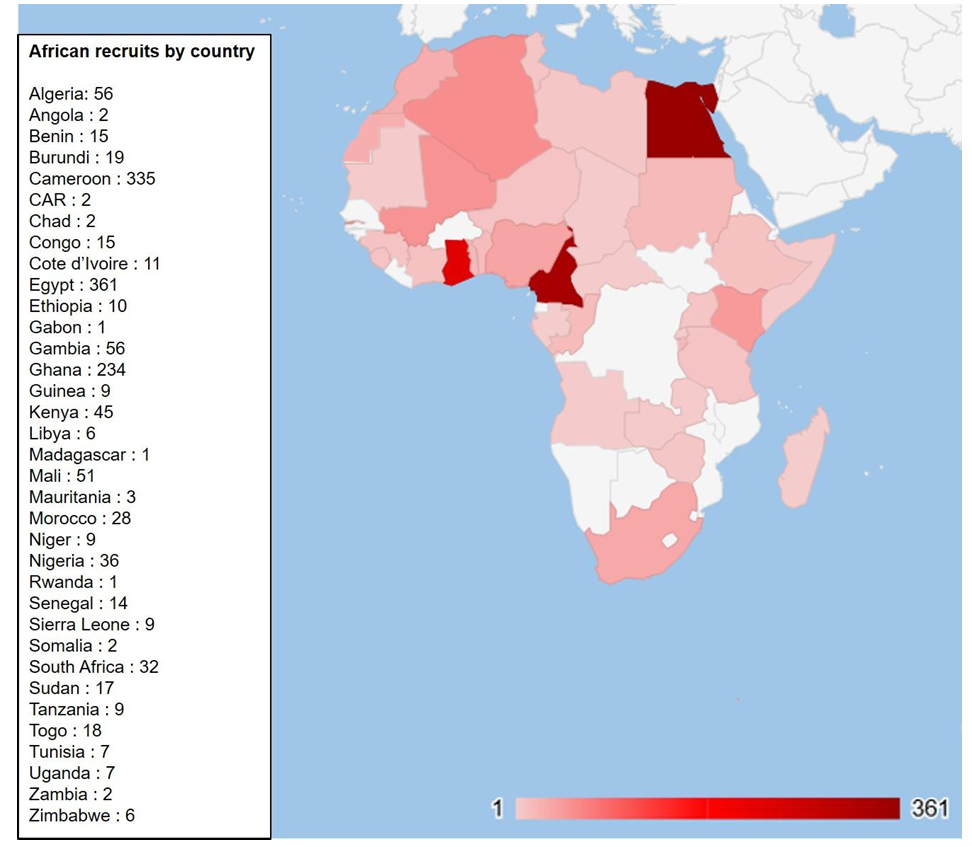
Map from the NGO INPACT report (February 2026) showing the number of African nationals identified as recruited into the Russian army. The dataset analyzed by the organization lists 1,417
recruits from more than thirty African countries, including seven Tunisians.
He was identified as Haykel Essid, born on September 30, 1995. Two of his friends, who tried to locate him after his disappearance, reconstructed his trajectory based on the information they were able to gather. During their investigation, they discovered,
on a Telegram channel, a document presented as a
list of missing personnel from the 20th and 150th Motor Rifle Divisions of the 8th Combined Arms Army of the Armed Forces of the Russian Federation. On line 6,804 appears the Russian transliteration of Haykel Essid’s name, along with his date of
birth, September 30, 1995.
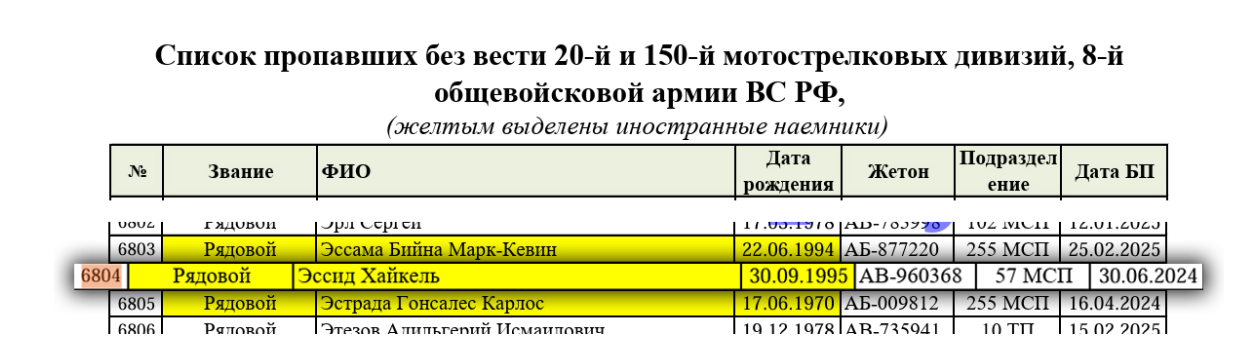
Excerpt from a document listing soldiers reported missing within the 20th and 150th Motor Rifle Divisions of the 8th Russian Army. The name of Haykel Essid, a Tunisian national born on
September 30, 1995, appears on the list with an associated date of June 30, 2024.
He is listed as a private, assigned to the 57th Motor Rifle Regiment, under dog tag number АБ-960368, and declared killed in action on June 30, 2024. His entry is highlighted in yellow: according to the document’s legend, this color designates foreign
nationals. His name also appears in the INPACT database, among the seven Tunisian nationals identified. The document’s format—rank, full name, date of birth, dog tag number, unit, date of combat—matches Russian military records documented since 2022
by organizations specializing in tracking casualties casualties, notably
Mediazona. Its authenticity, however, could not be independently verified. According to the same sources, the family has declined to speak publicly.
The cases of Aymen, Montassar, and Haykel belong to a much broader phenomenon.
Since 2023, Russia has stepped up its overseas recruitment efforts to offset its losses in Ukraine and circumvent the impact of international sanctions. According to the INPACT report, the Kremlin has rolled out a structured campaign primarily targeting
the African continent. The profiles targeted follow a consistent pattern: young applicants seeking to study abroad, job seekers looking for an economic way out, and prospective migrants for whom Russia is presented as a gateway to Europe. Documented
recruitment channels include fake travel agencies, fictitious job offers, and promises of administrative regularization.
Forced recruitment in prisons constitutes the other pillar of this strategy. As early as March 2023, experts mandated by the
United Nations Human Rights Council reported that representatives of the Wagner Group were visiting Russian prisons to enlist detainees—including foreign nationals—under threat or coercion. In June 2023, Vladimir Putin signed a law transferring
this prison recruitment program to the direct authority of the Ministry of Defense, through the creation of so-called “Storm-V” units. According to data provided by Ukrainian military intelligence to CNN in November 2025, of the more than 18,000 foreign
fighters identified within Russian ranks, at least 3,388 have been killed.
In Aymen and Montassar’s cases, the judicial and military documents confirm this modus operandi point by point. In Haykel Essid’s case, the traces are more fragmentary. The outcome, however, is the same: a young man who left for Russia and ended up reported
dead in a war that was never supposed to be his.
Migration Pathways or Recruitment Pipelines? The Travel Agency Question
In Tunisia, some agencies offer study and work programs in Russia that are accessible without a high school diploma. Aymen, Montassar, Moussa and, based on the information gathered, Haykel, all went through this channel. At this stage of the investigation,
there is no evidence establishing a direct link between these agencies and the military recruitment system. However, the profiles they produce—young individuals who are isolated, financially unstable, without legal recourse, and operating in a language
they do not master—closely match those identified in the INPACT report as the most vulnerable targets.
The Tunisian intermediary who organized Aymen’s trip, contacted by Inkyfada, confirms this structure from the inside. While not the main coordinator of departures, he describes the role of a central organizer based in Russia, who managed relations with
the Russian side and facilitated university enrollments, including for candidates without a high school diploma. He says he personally handled some of these young men’s applications in Tunisia and even visited their families when visas were issued.
According to him, this organizer no longer resides in Russia and is now based in Luxembourg.
He also describes—without fully grasping the implications—what becomes of a young person once they arrive with no safety net: reliant on informal jobs found via Telegram, without local representation, and with no access to legal counsel in times of crisis.
“Sending people abroad is a responsibility,” he says. It is precisely this sense of responsibility that led him to abandon the sector—one that the system itself has exploited.
Inkyfada also contacted an agency that, until recently, was offering departures to Russia. It now operates under a different name from the one it used at its founding, although the former branding remains visible inside its premises. Its manager agreed
to meet with a journalist posing as a prospective candidate for departure. She openly describes how the market operates: a matchmaking platform called “
Humanlink,” also known as “
AnyJob,” through which job offers from abroad are channeled.
Among them was a Russian program aimed exclusively at young women, known as Alabuga Start. It offered jobs in an industrial zone in the Tatar region of
Alabuga, which the agency’s manager presented as “a Muslim region” in order to reassure families. Candidates had to be between 18 and 20 years old. “They were asking for girls to work in manufacturing plants, in food-processing factories,” she explains.
The program had already operated in other African countries. In Tunisia, however, it ran up against family resistance. “The father tells you: I’m not letting my 18-year-old daughter go.” The agency says it eventually dropped the program.
What stands out in this account is less the program’s failure than the description of the institutional channel behind it. The manager mentions that representatives of the Russian Chamber of Commerce came to Tunisia to revive the recruitment drive. “The
Russian Chamber of Commerce came and said: why aren’t you finding us girls?”
These accounts do not constitute direct evidence implicating these agencies in the fate of the young men whose trajectories this investigation retraces. At this stage, no direct causal link can be established between departures facilitated by these structures
and subsequent military enlistment. What they do document, however, is the existence of an informal recruitment ecosystem—connected to official Russian interests—that places young Tunisians in highly vulnerable situations on Russian territory.
When Silence Speaks: The Authorities’ Inaction
Faced with these trajectories, we reached out to the relevant authorities. The Tunisian embassy in Russia, contacted by both email and phone, did not respond. The Tunisian Ministry of Foreign Affairs, approached through the same channels, also remained
silent.
The Russian embassy in Tunisia eventually replied:
“The Embassy of Russia in Tunis does not engage in the conclusion of enlistment contracts within the Armed Forces of the Russian Federation.”
It added that:
“under current national legislation, this responsibility falls under the jurisdiction of the Russian Ministry of Defense,” and invited us to “contact the press service of the said Ministry” for any further information. Contacted in turn, the Russian Ministry of Defense has still not responded.
The official Russian position is set out in greater detail in a
statement published on February 19, 2026, by the Embassy of the Russian Federation in Kenya, in response to reports suggesting the involvement of Kenyan nationals in the war in Ukraine. The statement asserts that the embassy “rejects these allegations
in the strongest possible terms.” “The Russian government authorities have never engaged in illegal recruitment into the Armed Forces of the Russian Federation,” it concludes.
The text, however, includes a qualification that is significant:
“The legislation of the Russian Federation does not preclude foreign citizens from voluntarily enlisting in the Armed Forces of the Russian Federation, provided they are legally present in Russia and choose to take part in combat against Ukrainian Nazism supported by NATO, alongside Russian servicemen.”
The official line thus draws a distinction between “illegal recruitment” and what is framed as voluntary and legally sanctioned enlistment. In the cases of Aymen and Montassar, the term “voluntary enlistment” is unlikely to carry the same meaning..
For the families of Aymen, Montassar and Haykel Essid, the issue goes beyond the diplomatic framing of the term “recruitment.” Their concern is far more basic: to know where their children are.